
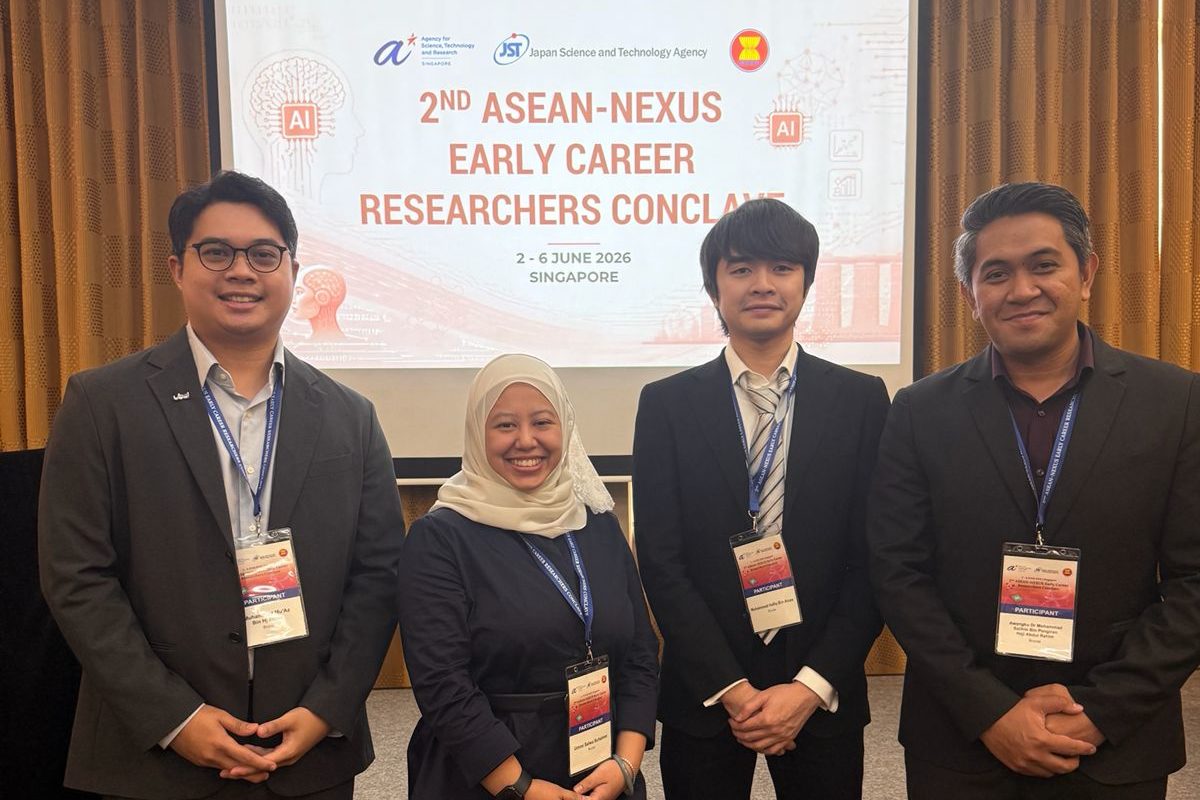
Held from 2–6 June 2026 in Singapore, the conclave provided opportunities for research exchange, international networking, funding exploration, and engagement with leading research institutions.
A delegation of researchers from Universiti Brunei Darussalam (UBD) participated in the 2nd ASEAN-NEXUS Early Career Researchers (ECRs) Conclave 2026, held in Singapore from 2 to 6 June 2026. The five-day programme brought together early career researchers, academics, research leaders, and representatives from funding agencies across ASEAN and Japan to foster collaboration, knowledge exchange, and partnerships in science, technology, and innovation.
The conclave commenced with a Poster Presentation Session, where participants presented their ongoing research and engaged in discussions with fellow researchers and experts from across the region. The session provided a platform for exchanging ideas, receiving feedback, and exploring potential interdisciplinary collaborations.
Representing UBD, Dr Muhammad Mu’az Imran, a Lecturer from the Faculty of Integrated Technologies, presented his research entitled “Spatiotemporal Data Analytics for In-Process Quality Assurance in Directed Energy Deposition,” which explored the application of machine learning and spatiotemporal analytics for quality monitoring in additive manufacturing processes. The research demonstrated how artificial intelligence can support real-time process monitoring, defect detection, and quality assurance in advanced manufacturing environments.
Awg Muhammad Hafiq Anas, a PhD Candidate at the RoboLab, School of Digital Science, presented his research on “Crowd Navigation for Mobile Robots with Focused Risk Perception.” The study investigated the development of autonomous mobile robot navigation systems capable of identifying and prioritising environmental risks in crowded environments, contributing towards safer and more intelligent robotic systems for real-world applications.
Meanwhile, Dyg Ummi Salwa Suhaimei, a PhD Candidate from PAPRSB Institute of Health Sciences and the School of Digital Sciences, presented her research entitled “Machine Learning-Based Risk Stratification for Colorectal Cancer: Towards a Digital Screening Tool for Brunei.” The study explored the use of machine learning techniques to identify individuals at elevated risk of colorectal cancer, supporting targeted screening strategies and contributing towards the advancement of digital healthcare solutions in Brunei.
The programme also featured a series of Keynote Lectures and Panel Discussions delivered by distinguished speakers from academia, research institutions, and funding agencies. Among the keynote speakers were Professor Tomohiro Shibata from the Kyushu Institute of Technology, Professor Loh Xian Jun, Executive Director of the Institute of Materials Research and Engineering (IMRE), A*STAR Singapore, and Associate Professor Malika Meghjani from the Singapore University of Technology and Design (SUTD). Their presentations explored the role of artificial intelligence in scientific discovery, materials research, autonomous systems, and interdisciplinary innovation, while emphasising the importance of strong ASEAN–Japan research partnerships. A panel discussion on advancing ASEAN–Japan AI partnerships further highlighted opportunities for international collaboration, talent development, and responsible innovation.
Participants also attended a dedicated session on Funding Opportunities from the A*STAR, Singapore, and the Japan Science and Technology Agency (JST). The briefing introduced various programmes that support international research collaboration, researcher mobility, postgraduate training, and fellowship opportunities. These included ASTAR’s Singapore Research Attachment Programme (SRAP), **ASTAR Research Attachment Programme (ARAP)**, and Singapore-Southeast Asia Fellowship (S-SEAF), as well as JST’s e-ASIA Joint Research Program (e-ASIA JRP), Science and Technology Research Partnership for Sustainable Development (SATREPS), and NEXUS Programme. The session provided valuable insights into pathways for establishing collaborative research projects and strengthening institutional partnerships across ASEAN and Japan.
As part of the conclave programme, participants visited the A*STAR, including the Advanced Remanufacturing and Technology Centre (ARTC) and the Institute of Materials Research and Engineering (IMRE). The visits provided exposure to Singapore’s research and innovation ecosystem and highlighted ongoing efforts in advanced manufacturing, artificial intelligence, robotics, automation, and materials science. A key highlight was the introduction to IMRE’s MARVEL (Materials Autonomous Research, Validation and Experimentation Laboratory) platform, which integrates autonomous experimentation, robotics, machine learning, and AI-assisted decision-making to accelerate materials discovery and development. Participants also learned about Alloy Generative Intelligence (AlloyGen AI), a generative AI platform that supports alloy design, materials optimisation, and predictive modelling for advanced manufacturing applications.
The delegation also visited the Singapore University of Technology and Design (SUTD), where faculty members presented the university’s interdisciplinary and design-centric approach to education and research. Participants gained insights into ongoing research initiatives in engineering systems design, cognitive intelligence and generative AI, embodied AI and robotics, advanced materials, and digital technologies. The visit highlighted the growing importance of interdisciplinary collaboration in addressing complex scientific and societal challenges through artificial intelligence and emerging technologies.
The programme concluded with a visit to Nanyang Technological University (NTU) and the Energy Research Institute @ NTU (ERI@N). Participants were introduced to NTU’s research initiatives in renewable energy, battery technologies, smart grids, electrification, future mobility, and sustainable urban development. A tour of the Advanced Batteries Prototyping Facility provided first-hand exposure to next-generation energy storage technologies and research infrastructure supporting sustainable energy transitions.
Through research presentations, discussions with leading experts, engagement with funding agencies, and visits to Singapore’s premier research institutions, the conclave provided valuable opportunities for UBD researchers to expand their professional networks, gain insights into emerging research trends, and explore avenues for future international collaboration. Participation in the programme reflects UBD’s continued commitment to strengthening regional partnerships and advancing research excellence within the ASEAN and Japan research community.