
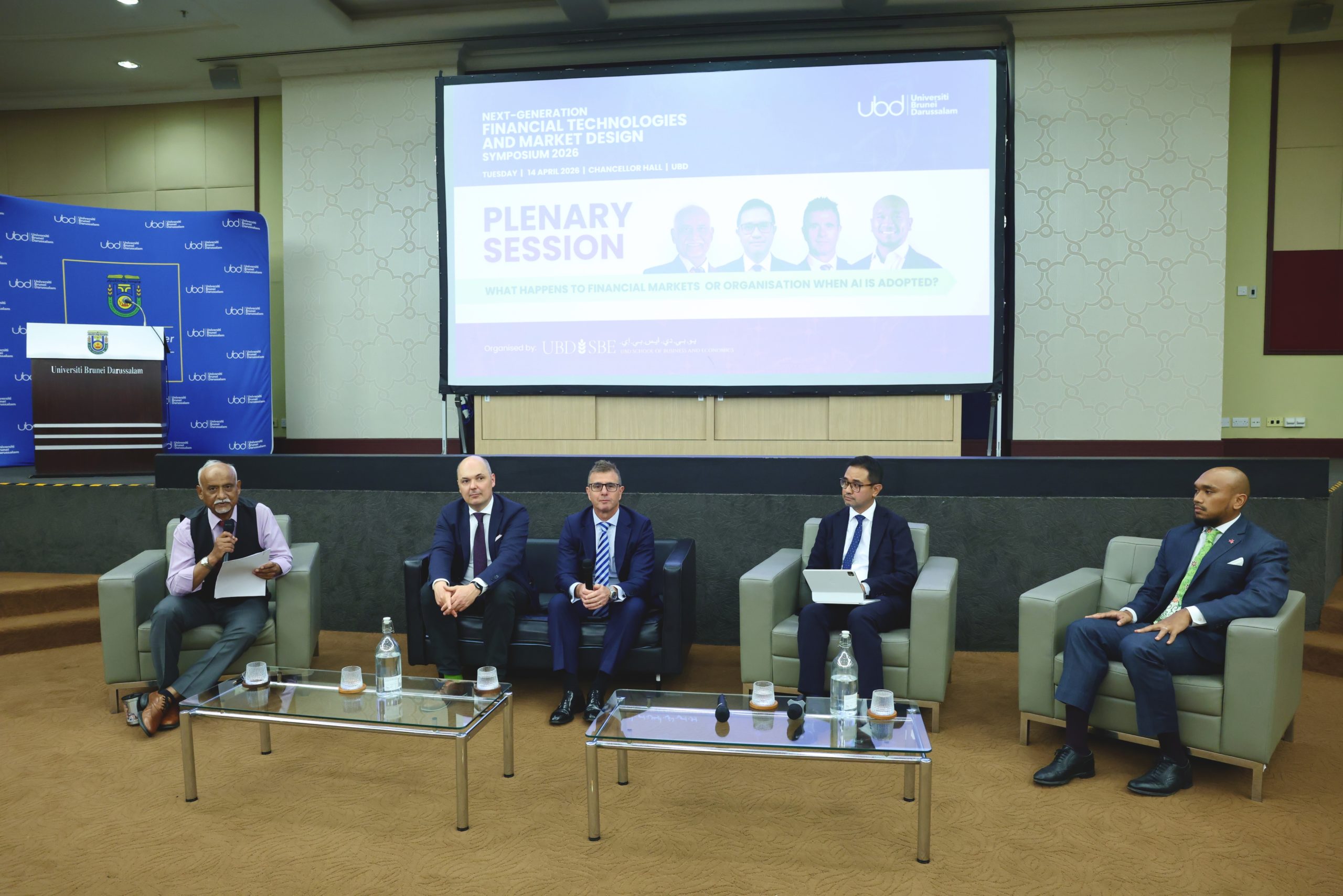
As artificial intelligence (AI) rapidly reshapes how money moves, decisions are made, and risks are managed, a symposium hosted by Universiti Brunei Darussalam School of Business and Economics (UBDSBE), ‘Next-Generation Financial Technologies and Market Design Symposium 2026’ opened up the conversation on what this could mean for businesses, policymakers, and everyday users of financial services.
Held on 14th April 2026 at the Senate Room, UBD, the symposium brought together leading academics, policymakers, and industry experts to examine how AI has already changed financial systems and what needs to happen next to ensure those changes are safe, fair, and beneficial.
The event featured a keynote address titled, ‘GenAI and Financial Advice’ delivered by Professor Dr Lars Hornuf, Chair Professor of Business Administration (Finance and Fintech), Dresden University of Technology and Visiting Professor at UBD, internationally recognised for his research in financial technology, digital finance, and market design.
The programme also included a plenary session titled “What Happens to Financial Markets and Organisations When AI is Adopted?”, which explored the implications of AI adoption for market structure, efficiency, and financial stability. A distinguished panel comprising representatives from academia, industry, and the Brunei Darussalam Central Bank contributed to discussions on regulatory challenges, financial innovation, and the evolving role of market design in AI-driven environments.
The panel featured Professor Ishaq Bhatti of Accounting and Finance, UBDSBE; Pg Haji Shahrulazmi Pg Dr Haji Ismail of the Regulatory and Supervisory Group at Brunei Darussalam Central Bank; Angelo Calvitto, Head of Asia Pacific Region at Northern Trust; and Hafiz Haslen, Chief Executive Officer of the National Digital Payments Network.
The discussion addressed key themes following the impact of AI on financial market structure and performance, regulatory and supervisory considerations in digital finance, market design in relation to transparency, fairness, and systemic risk, and the strategic responses of financial institutions to technological change.
Overall, the programme reflected UBD’s continued commitment to advancing research and dialogue at the intersection of finance, technology, and policy. It also provided a platform for engagement between academia, regulators, and industry stakeholders in addressing emerging challenges and opportunities in the financial sector.
For more information, please visit www.sbe.ubd.edu.bn