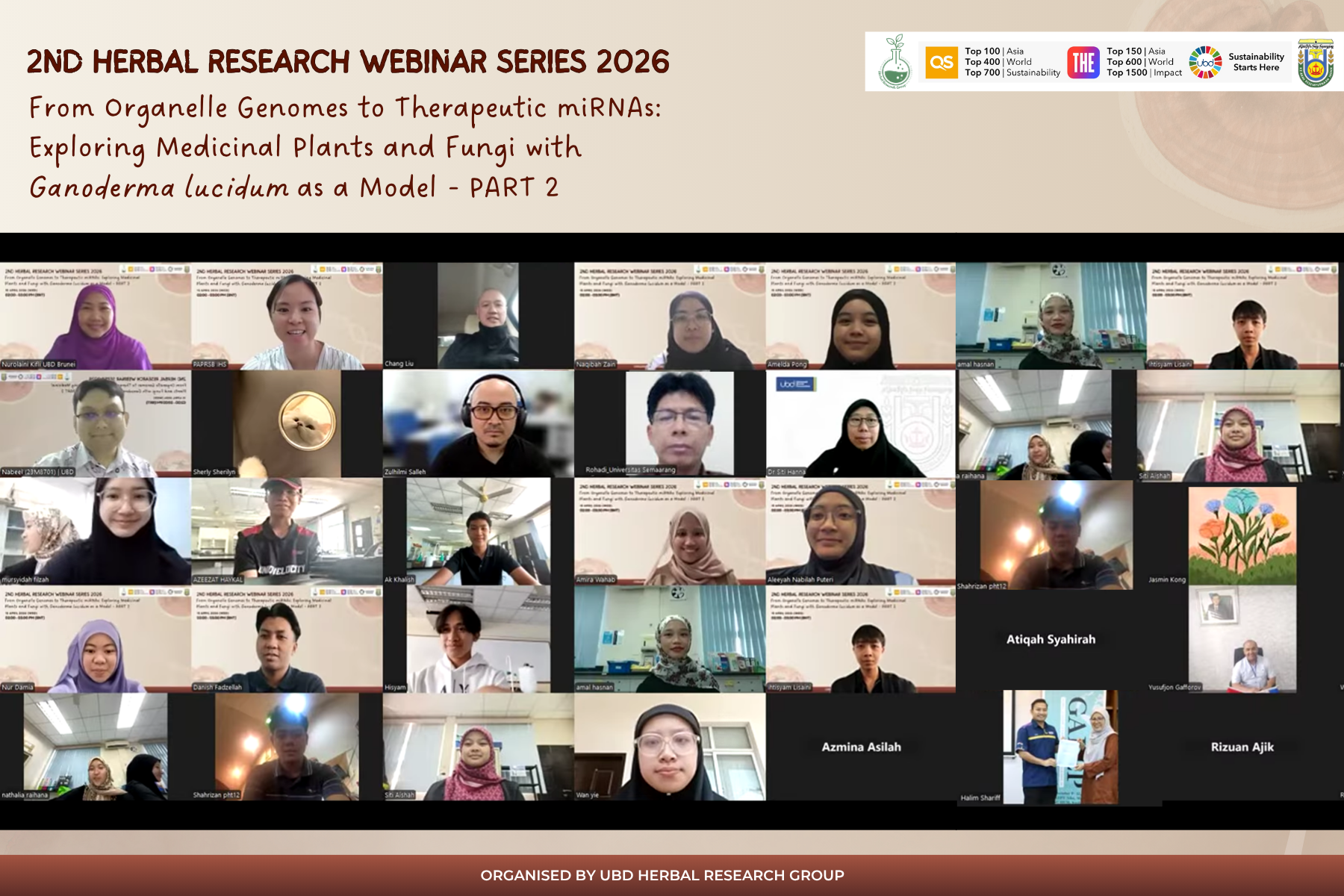
Advances in herbal and medicinal research continue to open new possibilities for future therapies and healthcare innovation, as highlighted during the 2nd Herbal Research Webinar Series 2026 hosted by Universiti Brunei Darussalam (UBD) through its Herbal Research Group (HRG). The session brought together academics, researchers, and professionals to explore how modern science is shaping the future of plant-based medicine.
The webinar featured Liu Chang, Professor, Doctoral Supervisor, and Deputy Director at the Center for Bioinformatics, Institute of Medicinal Plant Development (IMPLAD), Chinese Academy of Medical Sciences (CAMS), Beijing, People’s Republic of China. The session continued from his earlier presentation, focusing on emerging developments in medicinal plant and fungal research.
A total of 40 participants attended the webinar, comprising academics, researchers, students, and professionals from UBD, as well as other national and international institutions, private companies, and government agencies. The diverse participation reflected growing interdisciplinary interest and regional engagement in herbal research.
In his presentation titled “From Organelle Genomes to Therapeutic mRNAs: Exploring Medicinal Plants and Fungi with Ganoderma lucidum as a Model (Part 2)”, Professor Liu shared insights from over a decade of research on Ganoderma lucidum, a medicinal fungus widely used in traditional medicine. He explained how advanced genetic and data-driven tools, including genomics, transcriptomics, and bioinformatics, are used to better understand how such organisms produce bioactive compounds with potential health benefits.
The session also explored how non-coding RNAs influence gene expression and metabolic pathways, alongside the use of emerging technologies such as gene editing to develop improved strains with enhanced therapeutic potential. Professor Liu further highlighted translational research linking natural products to modern therapeutic applications, including promising developments in RNA-based approaches in cancer research.
The webinar concluded with an interactive question-and-answer session, where participants discussed the future of herbal research, potential industry applications, and opportunities for collaboration. The exchange underscored the importance of integrating traditional knowledge with modern scientific approaches to address evolving global health challenges.
The Herbal Research Webinar Series is part of HRG’s ongoing initiative to provide a platform for knowledge exchange, capacity building, and international collaboration. Through such engagements, UBD continues to strengthen its role in advancing research excellence and fostering innovation with real-world relevance in the region.