
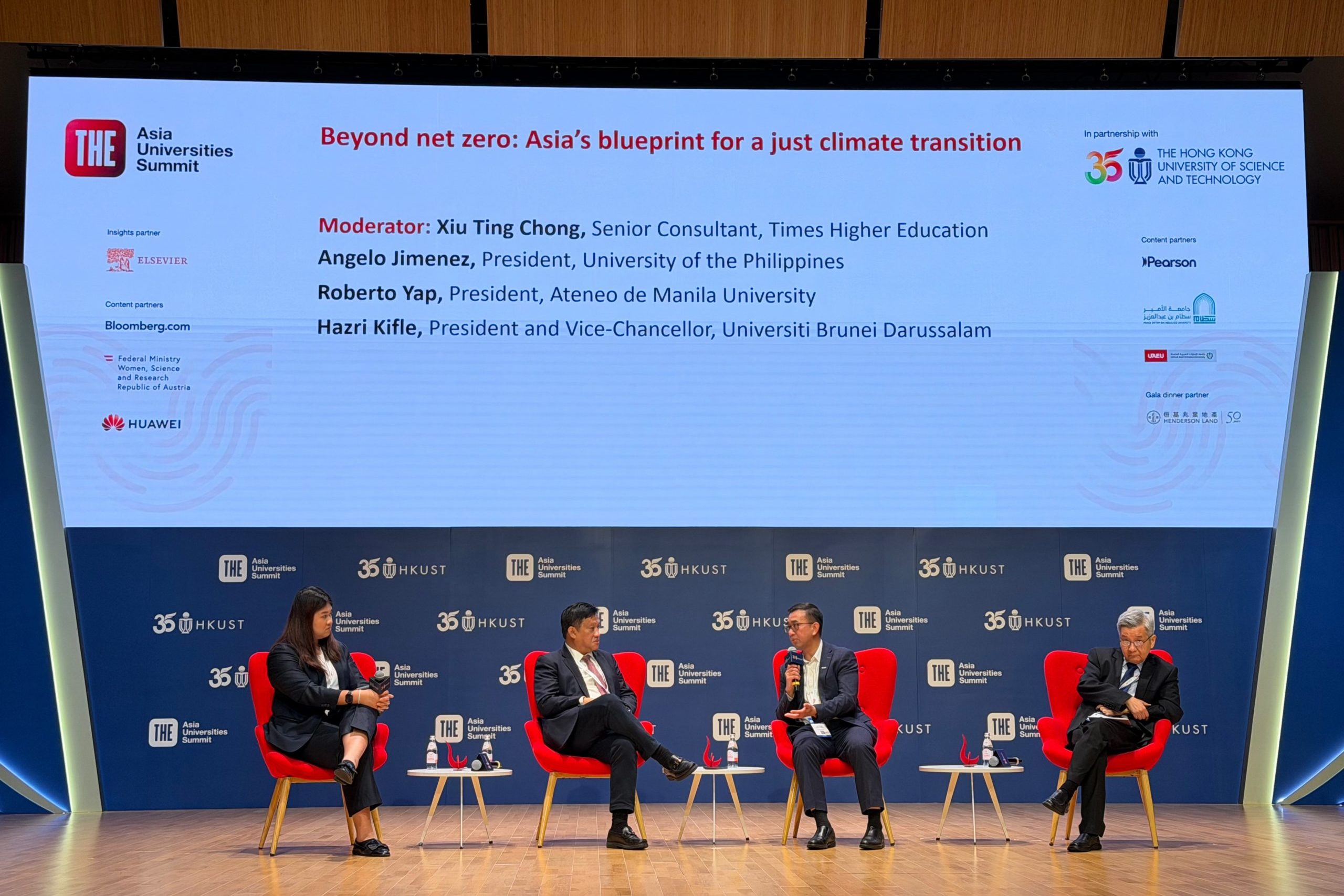
When Universiti Brunei Darussalam’s Vice-Chancellor Dr. Hazri bin Haji Kifle took to the stage at the Times Higher Education Asia Universities Summit 2026 in Hong Kong last week, his message was direct: universities cannot afford to be bystanders in the climate transition.
Speaking on a panel titled Beyond Net Zero: Asia’s Blueprint for a Just Climate Transition, Dr. Hazri argued that for nations like Brunei — which face both the pressures of decarbonisation and the realities of an energy-dependent economy — universities have a specific and urgent responsibility. That responsibility is threefold: preparing graduates who can create the industries of the future, not just fill jobs in existing ones; supplying policymakers with the evidence they need to make sound decisions; and building the pool of homegrown experts that a green economy will require.
“We are not preparing students for a world we know. We are preparing them for a world we are still building.”
— Dr. Hazri bin Haji Kifle, Vice-Chancellor, Universiti Brunei Darussalam
For Brunei, that world is already taking shape. UBD is actively building research capacity and a technical talent pipeline around green hydrogen — one of the most strategically significant emerging sectors for Brunei’s post-carbon future. With its solar resources, existing energy infrastructure, deepwater port access, and established trade relationships with Japan and South Korea — two of the world’s largest anticipated hydrogen importers — Brunei has real natural advantages. UBD’s role is to ensure that when the conditions align, Brunei has the expertise, the graduates, and the voice at the table to be a participant in that economy, not merely a location for it.
UBD’s evolving GenBESTARI undergraduate curriculum and its Discovery Year programme reflect the same philosophy: producing graduates who are adaptive and entrepreneurial, capable not just of responding to economic change but of shaping it.
The defining question for Asia, Dr. Hazri concluded, has never been whether to transition — it is how, and for whom. A just transition is not a slower transition. It is a smarter one: protecting livelihoods while building new ones, grounded in local reality rather than frameworks designed for very different economies. That is the work universities are uniquely positioned to do.
About the Times Higher Education Asia Universities Summit 2026
Held in Hong Kong from 22–24 April 2026 and organised in partnership with The Hong Kong University of Science and Technology, the summit brought together university leaders from across Asia to explore the region’s rise as a global centre of innovation and the role of higher education in shaping humanity’s future.
About Universiti Brunei Darussalam
Universiti Brunei Darussalam (UBD) is Brunei’s national research university, established in 1985. UBD’s GenBESTARI curriculum and Discovery Year programme are designed to produce graduates who are academically rigorous, values-grounded, and equipped to contribute to a changing economy. UBD conducts applied research in areas including green hydrogen, biodiversity, precision medicine, and halal science.