
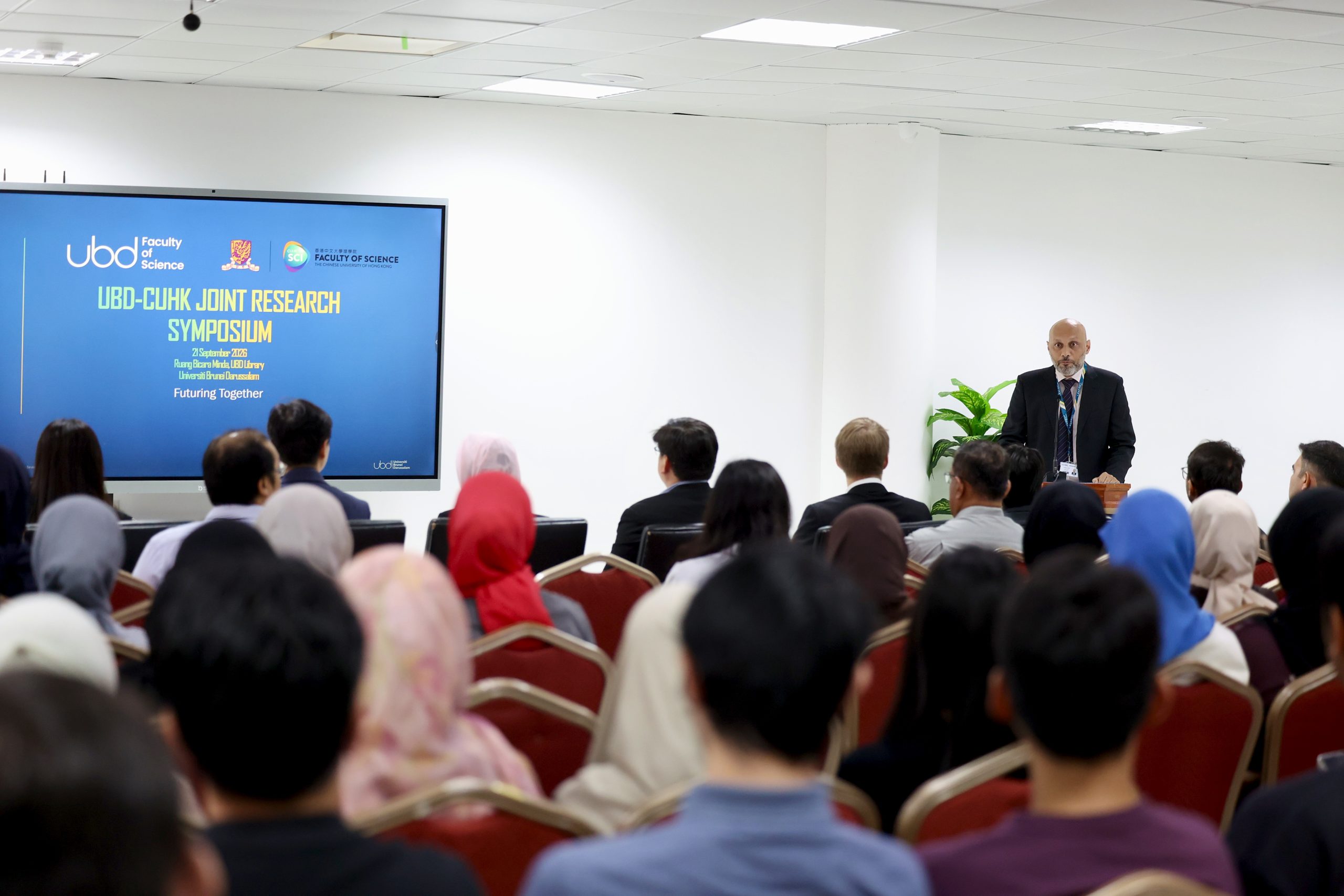
Universiti Brunei Darussalam (UBD), through the Faculty of Science (FOS), hosted the UBD–CUHK Joint Research Symposium on 21st September 2026, bringing together academics, researchers and students from UBD and The Chinese University of Hong Kong (CUHK) for an afternoon of scientific exchange, research sharing, and academic networking.
The symposium provided a valuable platform for strengthening institutional partnerships, boosting international visibility, and exploring new avenues for collaborative research and joint publications across multiple scientific disciplines.
Held at Ruang Bicara Minda, UBD Library, the symposium showcased cutting-edge research from CUHK while highlighting UBD’s growing research strengths in chemical sciences, mathematical sciences and applied physics. The event also provided opportunities for students and researchers to engage directly with leading academics from both institutions and to explore future postgraduate and research opportunities.
The symposium was officially opened by Associate Professor Dr Malai Haniti Sheikh Abdul Hamid, Dean of FOS, UBD, who welcomed participants and reaffirmed the importance of international academic partnerships in advancing research excellence, innovation and knowledge exchange.
A highlight of the symposium was a series of presentations by distinguished CUHK academics. Professor Hoi Ying Wong from CUHK’s Department of Statistics and Data Science presented his research on Virtual Battery Tolling Agreements, offering insights into innovative approaches for supporting battery storage flexibility and addressing challenges in modern energy systems through advanced mathematical and financial modelling.
Participants also gained perspectives on sustainable materials research through a presentation by Professor To Ngai of CUHK’s Department of Chemistry. His talk highlighted recent developments in green polysaccharide coatings and Kombucha cellulose films as environmentally friendly alternatives for paper packaging applications, contributing to global efforts towards sustainability and reducing plastic waste.
Adding an astrophysical dimension to the programme, Professor Otto Akseli Hannuksela from CUHK’s Department of Physics shared his research on gravitational waves and the origins of merging black holes. His presentation explored how gravitational-wave observations and optical surveys can help scientists better understand the formation and evolution of black holes across the Universe.
Complementing the presentations by the CUHK delegation, UBD researchers showcased research activities across several programmes within the Faculty of Science. Dr Habib Ullah, Dr Sakander Hayat and Associate Professor Dr Piyasiri Ekanayake presented research highlights from the Chemical Sciences, Mathematical Sciences and Applied Physics programmes, respectively, demonstrating the breadth and diversity of scientific research being undertaken at UBD.
Beyond the scientific presentations, the symposium featured networking opportunities, postgraduate programme sharing sessions, and consultations with undergraduate and postgraduate students. These engagements enabled direct interaction between students and members of the CUHK delegation, fostering meaningful discussions on academic pathways, research collaborations, and future educational opportunities.
The UBD–CUHK Joint Research Symposium reflects the shared commitment of both institutions to advancing research excellence, promoting internationalisation, and nurturing the next generation of scientists and researchers. By bringing together expertise in statistics, data science, chemistry, physics and applied sciences, the symposium strengthened academic ties between UBD and CUHK while creating new opportunities for collaborative research with regional and global impact.
As UBD continues to expand its international research network, initiatives such as this symposium play an important role in fostering interdisciplinary collaboration, enhancing research visibility and supporting the University’s mission to contribute meaningful solutions to scientific, technological and societal challenges.