
UBDSDS Showcases Mimoru: Social Robotics Innovation @ IEEE RO-MAN 2026 in Kitakyushu, Japan
KITAKYUSHU, JAPAN, 28th August 2026 – A robot developed by a researcher at Universiti Brunei Darussalam (UBD) was selected for the Robot Design Competition at the 35th IEEE International Conference on Robot and Human Interactive Communication (IEEE RO-MAN 2026), bringing UBD’s work in robotics and human-robot interaction (HRI) to an international audience of more than 600 attendees in Kitakyushu, Japan.
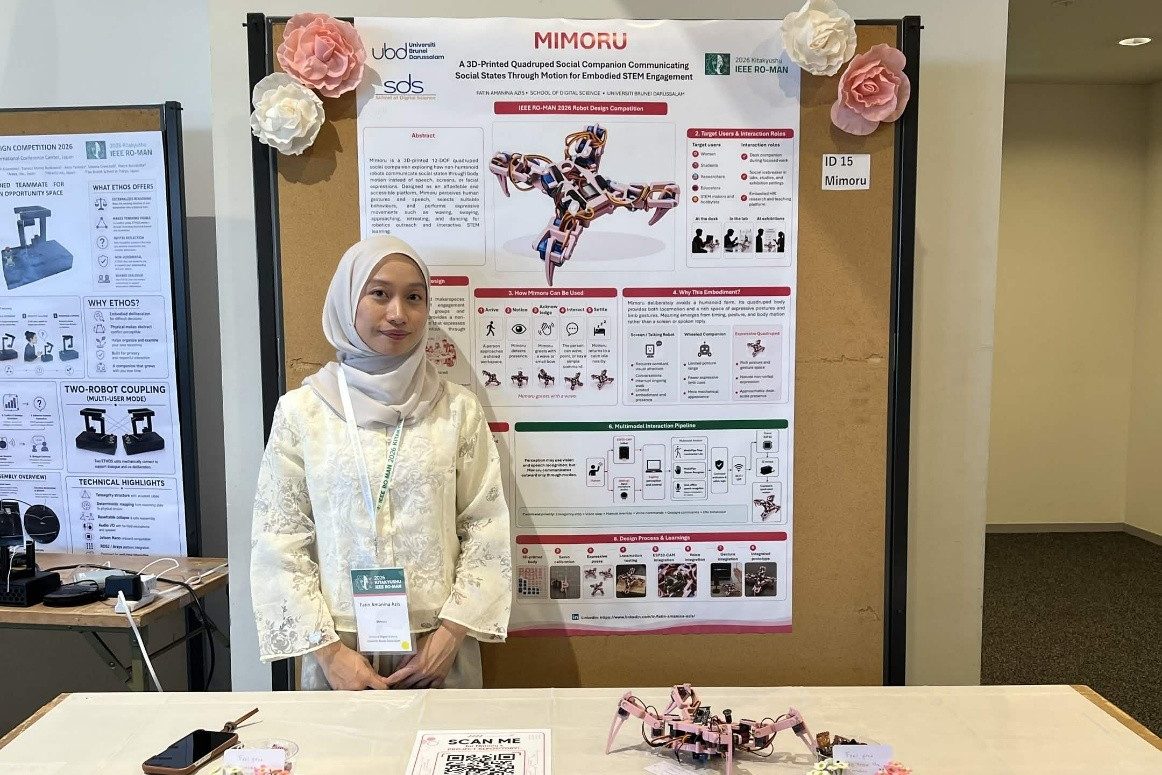
Dr Fatin Amanina Azis, Lecturer at the School of Digital Science (SDS), UBD, presented Mimoru, a 3D-printed 12-degree-of-freedom quadruped social companion designed to explore how non-humanoid robots can communicate social states through expressive body movement.
Held from 24th to 28th August 2026 at the Kitakyushu International Conference Center, IEEE RO-MAN brought together researchers, practitioners and students working across human-robot interaction, robotics, artificial intelligence (AI), psychology, cognitive science, design and related fields. The 2026 conference was themed “Realizing Human-Robot Symbiosis with AI.”
Mimoru was one of the projects selected for the conference’s Robot Design Competition following a submission and acceptance process, with accepted projects invited to present and demonstrate their work during the competition. Mimoru was featured among the participating projects in the official programme and on the conference website.
Exploring Communication Through Movement
Mimoru was developed by Dr Fatin as part of her robotics work at UBD, supported by UBD funding and SDS, which enabled her participation at the international conference.
Unlike many social robots that communicate through human-like faces, screens or spoken dialogue, Mimoru explores movement as a form of non-verbal communication.
The robot has four legs, each with three independently controlled joints, giving it 12 degrees of freedom. This allows Mimoru to perform expressive movements such as waving, raising or lowering its body, swaying, approaching, retreating and dancing.
Human cues, including body gestures, poses and selected voice commands, can be recognised by a connected perception system and translated into corresponding behaviours. These commands are then sent wirelessly to Mimoru, whose onboard controller coordinates its servo motors to produce the intended movement.
Through these behaviours, movement can convey different social states. Approaching, for example, can signal engagement, while retreating can communicate a response to personal space. Waving and swaying can serve as greeting or expressive behaviours.
Making Robotics More Approachable
Accessibility was also an important consideration in Mimoru’s design. Its small size, expressive character and relatively low-cost construction using 3D-printed components and readily available electronics were intended to make robotics feel less intimidating and more approachable, particularly for learners with limited previous exposure to engineering.
Dr Fatin also sees potential for the platform to encourage greater participation among girls and women in robotics, AI and other STEM fields by presenting technology in a more approachable and creative form.
Learning from the International HRI Community
Participation in the Robot Design Competition gave Dr Fatin an opportunity to engage directly with researchers, experts and participants in robotics and HRI and gather feedback on Mimoru’s current design and future development.
Reflecting on the experience, Dr Fatin said: “Presenting Mimoru at IEEE RO-MAN in Japan was a very valuable experience because I was able to see how people responded to the robot, receive feedback from researchers in human-robot interaction, and learn from many different approaches being presented at the conference. I hope Mimoru and other robotics-related projects can continue to grow as both a research platform and an accessible way for students, especially girls and women, to become more interested in STEM, robotics and AI.”
Sharing the Project Beyond the Conference
To extend the project’s reach beyond the conference, Mimoru’s development resources, including its software code and project materials, have been made publicly available through an online repository (https://github.com/nixnaxnuxx/mimoru). The open resources allow researchers, students and developers to explore the project, build upon its development and potentially contribute to future iterations.
For UBD, the project demonstrates how research can connect technical innovation with education and wider public engagement. Mimoru has potential applications as a hands-on learning platform for areas including AI, computer vision, robotics, programming, human-computer interaction and embedded systems.
Its relatively low-cost and modular approach could also allow students to engage with robotics at different levels, from programming and physical design to experimentation and research.
The experience and feedback gained through the conference will inform the continued development of Mimoru and support future opportunities for research, student engagement and STEM outreach. The initiative reflects UBD’s commitment to research and innovation that is not only technically relevant, but also accessible, human-centred and connected to the development of future-ready talent.