
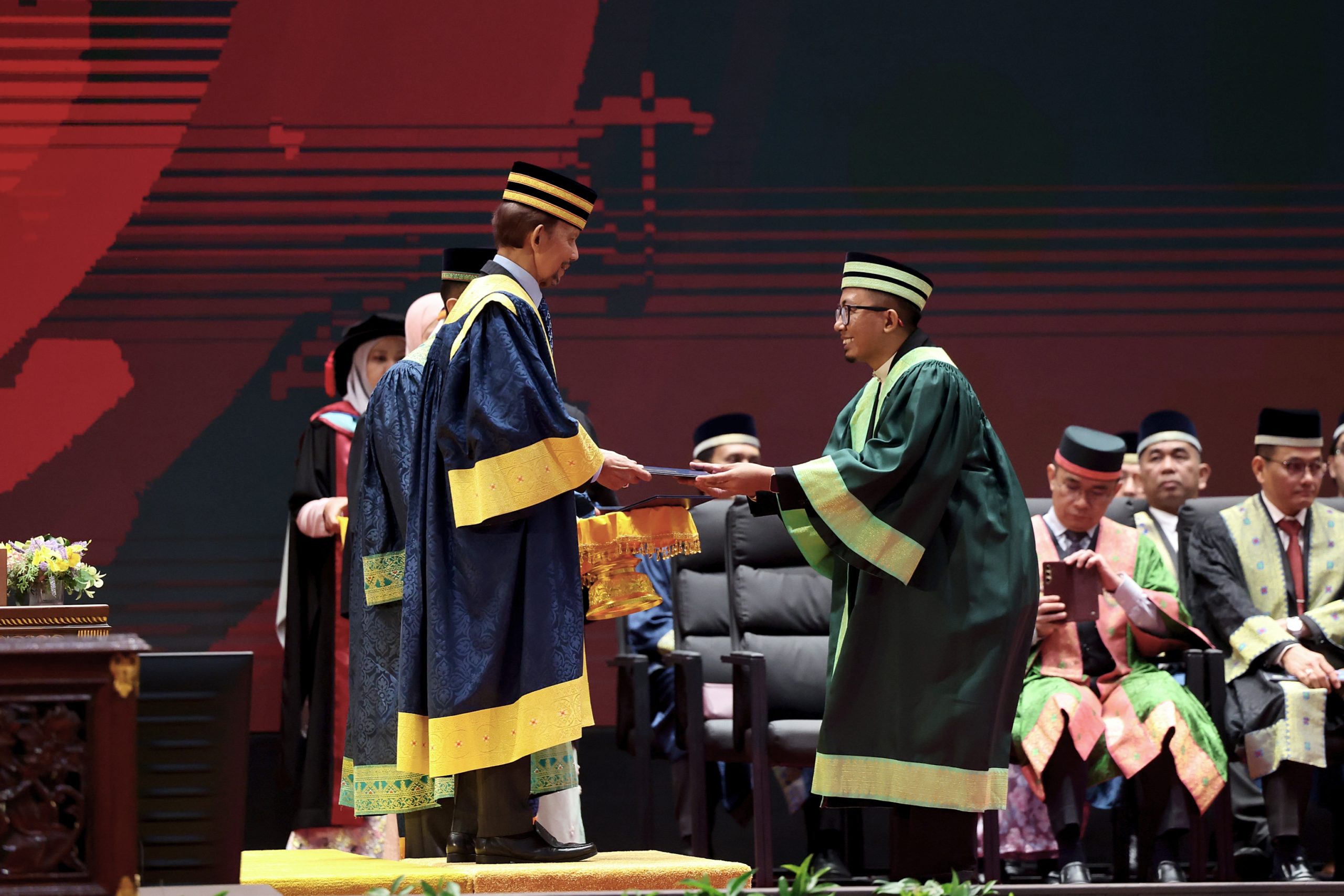
Universiti Brunei Darussalam (UBD) held its 38th Convocation Ceremony to celebrate the graduating class of 2026 at UBD’s Chancellor Hall on 11th August 2026.
His Majesty Sultan Haji Hassanal Bolkiah Mu’izzaddin Waddaulah ibni Al-Marhum Sultan Haji Omar ‘Ali Saifuddien Sa’adul Khairi Waddien, Sultan and Yang Di-Pertuan of Brunei Darussalam, Chancellor of UBD and His Royal Highness Prince (Dr) Haji Al-Muhtadee Billah Ibni His Majesty Sultan Haji Hassanal Bolkiah Mu’izzaddin Waddaulah, the Crown Prince and Senior Minister at the Prime Minister’s Office, Pro-Chancellor of UBD consented to attend the ceremony and present the certificates.
Receiving His Majesty and His Royal Highness the Crown Prince at the Chancellor Hall, UBD during the respective sessions were Minister of Education Yang Berhormat Datin Seri Setia Dr Hajah Romaizah Haji Mohd Salleh and UBD Vice-Chancellor Dr Hazri Haji Kifle.
This year saw a total of 1,181 graduates, consisting of 56 PhD graduates, 304 Master graduates, 806 Bachelor graduates, 5 Micro-Master graduates, as well as 10 Diploma recipients.
A total of 793 received their certificates from His Majesty the Sultan and Yang Di-Pertuan of Brunei Darussalam during the morning session which included PhD, Bachelor of Arts, Bachelor of Science, Bachelor of Business, Bachelor of Health Science, and Bachelor of Science in Digital Economy graduates. A total of 388 received their certificates in the afternoon from His Royal Highness the Crown Prince which included Master, Bachelor of Engineering, Bachelor of Digital Science graduates, Micro-master in Occupational Health and Safety, and Diploma in Inclusive Education recipients.
Convocation Firsts
For the first time in UBD’s convocation history, an Al-Hafiz recited verses from the Al-Quran to bless the ceremony. In front of all those present in the Chancellor Hall. Pengiran Muhammad Abdul Majeed Ariffin Pengiran Haji Muhammad Abdul Aziz, a Master of Science in Biodiversity graduate, recited Surah Saba verses 10 to 13. In addition to his academic success, he was also awarded the Ijazah Khas Hafaz Al-Quran 30 Juzuk by Universiti Islam Sultan Sharif Ali (UNISSA) in 2022 while he was still studying in UBD.
This year saw the first graduating cohort of the Bachelor of Digital Science in Artificial Intelligence and Robotics. Students undertaking the three-year undergraduate degree learn the multidisciplinary nature of AI and robotics. They develop understanding on electronics, mechanical and computing and learning physical computing for intelligent and Internet of Things (IoT).
The Artificial Intelligence and Robotics programme at the School of Digital Science (SDS) is a forward-thinking, interdisciplinary degree designed to cultivate the next generation of technologists capable of building intelligent systems for an increasingly digital world. Combining strong foundations in computer science, Artificial Intelligence (AI), machine learning, robotics, embedded systems, and data-driven technologies, the programme offers a curriculum that balances theoretical rigour with extensive practical experience. Students engage in programming, intelligent systems design, and project-based learning within state-of-the-art laboratories, tackling real-world challenges such as autonomous navigation, human–robot interaction, and intelligent data analysis. Supported by UBD’s research-informed teaching environment and emphasis on innovation, the programme prepares graduates to contribute meaningfully across sectors where intelligent automation, autonomous systems, and AI-enabled decision-making are becoming integral to economic and societal development.
A representative from the programme’s cohort, Sairul Behanam said that her time at SDS has been a journey of learning, exploration and personal growth. “I had the opportunity to explore different areas of technology, from robotics and augmented reality to machine learning, AI, and large language models. These experiences allowed me to gradually understand how the knowledge we learn in class can be applied to solve real-world problems,” she said. “One of the most meaningful parts of my undergraduate journey was my final year project, where I explored the use of supervised machine learning to predict hypertension risk using patient data. The project involved working with real-world medical data, data preprocessing, selecting and evaluating different machine learning models, and understanding how AI could potentially support healthcare. It was challenging, but it also gave me a much deeper appreciation for research and for the importance of applying technology responsibly to real-world problems.”
Assistant Professor of Intelligent Robotics and Programme Leader at SDS Dr Ajaz Ahmad Bhat said, “As Artificial Intelligence and robotics continue to transform industries worldwide, our graduates of the programme are poised to become pivotal architects of Brunei Darussalam’s digital transformation and economic diversification under the Wawasan Brunei 2035.”
“By developing expertise in automation and intelligent systems, they will directly address critical national needs: from optimising efficiency in the oil and gas sector through predictive maintenance and autonomous inspection, to revolutionising healthcare with AI-driven diagnostics and assistive robotics,” he added. “Beyond immediate industry applications, these graduates will serve as catalysts for a new innovation ecosystem in Brunei Darussalam, capable of launching deep-tech startups, driving research in tropical-specific robotics such as for agriculture or disaster response, and crafting homegrown solutions to reduce reliance on foreign technology. In a region rapidly embracing Industry 5.0, these professionals will not only fill a growing skills gap but will also shape the ethical practices and frameworks through which Brunei Darussalam will build a smarter, more sustainable, and self-reliant future.”
UBD also marks a significant milestone this year with the graduation of its first Micro–Master of Occupational Health and Safety cohort. A programme jointly offered by the Centre for Lifelong Learning (C3L) and Pengiran Anak Puteri Rashidah Sa’adatul Bolkiah Institute of Health Sciences (PAPRSB IHS), it supports legal requirements for designated workplace medical practitioners in Brunei Darussalam. The professional programme is aimed to equip lifelong learners with the fundamental knowledge and skills in occupational health and environmental health and safety and relevant competencies to implement programmes to promote a healthy workplace. Its contents are supported by cutting-edge research into the approaches that work best in practice. At C3L, learners can stack Lifelong Learning modules and complete them at their own pace. Upon completion of required modules, they can successfully graduate in their respective programmes.
One of the five graduates from the cohort, Wardatul Zahrah Abdul Razak shared that her experience at UBD through C3L has been great and rewarding. In addition to helpful, supportive and approachable lecturers, she pointed out how the lectures provided “top-notch insights” that she could apply directly to her professional work. “I gained new knowledge, strengthened my professional skills, and became more confident in my career,” she said.
She also recalled one of the highlights of her time in UBD being the collaboration with Mahidol University, Thailand which gave valuable international exposure and different perspectives on Occupational Health and Safety.
University achievements
After the presentation of certificates, His Majesty and His Royal Highness consented to tour a special exhibition that showcased highlights of the year. His Majesty viewed and officially launched the ‘UBD Digital Transformation Blueprint 2030′. The blueprint is the definitive institutional framework guiding UBD’s digital transformation over the next five years. A strategic framework that reshapes how UBD operates, teachers, researches and governs, the transformation means a seamless digital experience from admission to graduation and beyond. For UBD staff, intelligent systems ensure time is spent on teaching, research, and service.
The blueprint is the university’s institutional response to Digital Brunei 2030, a five-year masterplan led and monitored by the Digital Brunei Council to drive Brunei Darussalam’s digital growth, uniting Digital Government, Digital Society, Digital Business, and Data/AI Strategies under Wawasan Brunei 2035. Earlier in June this year, UBD underwent its first formal assessment under the ASEAN University Network Digital Transformation (AUN Dx) Framework.
‘UBD Digital Transformation Blueprint 2030’ is structured around three pillars: Infrastructure; Policy and Management; and Education and Research, delivered through the university’s central unified digital platform Nexus for Architecture, Data and Intelligence (NADI). It is guided by AISEnse, which oversees NADI’s development and ethical governance of AI.
One of UBD’s most historic events to date featured during the exhibition was the launch of seeds to the International Space Station (ISS). In collaboration with the Department of Agriculture and Agrifood at the Ministry of Economy, Trade and Industry with the Space Faculty Pte Ltd, Singapore, the project titled ‘Spaceflight-induced Seed Mutagenesis for Brunei’s Food Security and Resilience’ by the Institute for Biodiversity and Environmental Research (IBER) spearheaded the mission to expose indigenous rice seeds to cosmic radiation.
The initiative aims to trigger genetic variations that may result in new, high-yielding crop varieties. By leveraging orbital exposure, the project seeks to bolster national food sovereignty, which aligns with global sustainability goals. The collaboration is a significant step for Brunei Darussalam in using space technology to address environmental and food security challenges.
The third exhibit was the winning project at the AI Ready ASEAN Youth Challenge 2026, ‘Sahabat-Care’. The AI-powered dementia care platform was developed by PhD candidates from PAPRSB IHS and SDS: Ummi Salwa Suhaimei and Hein Minn Tun @ Salman.
Representing Brunei Darussalam under team ‘ΣHAI’, the duo’s project combines speech and language analysis, video-based behavioural observation, conversational AI and predictive analytics to support early detection of cognitive decline while improving accessibility and personalised caregiving support. The all-in-one AI tool detects memory loss from video analysis, providing round-the-clock guidance for caregivers and healthcare workers.
The achievement highlights UBD’s growing contribution to AI, digital public health and innovation-driven solutions that address real-world societal challenges. Sahabat-Care reflects the university’s continued commitment to developing human-centred and ethically grounded technologies that support healthcare accessibility, community wellbeing and regional collaboration.
Ongoing Festivities
Following the Convocation Ceremony, UBD invites graduates, along with their family and friends to ‘The Next Day’ on 12th August at the Chancellor Hall, a continuation of the celebrations that will feature vendors and photo opportunities. Graduates are welcome to return to the campus to immortalise fond memories in a more relaxed setting.
A key highlight of the event is the ‘Digital Thank You Message Wall’, which can be found in the Chancellor Hall lobby. It is an initiative that invites graduates to share heartfelt messages of appreciation for their parents, family members, friends, lecturers, mentors, and others who have supported them throughout their academic journey.
For updates and more information on the Convocation Ceremony and other activities on campus, follow @ubd_brunei on Instagram.